Showing posts with label Receipts. Show all posts

Tuesday, July 7, 2015

Angel Food, or White Sponge Cake - 1894 Receipt

Ingredients:
Angel Food Cake
  • 11 whites of eggs
  • 10 ounces of fine granulated sugar—all that can be shaken and heaped on a cup.
  • 5 ounces of flour—a cup moderately heaped.
  • 2 rounded teaspoonfuls of cream of tartar.
  • 2 teaspoonfuls of vanilla or lemon extract.
Get two pans together, put the cream of tartar into the flour and mix them by sifting out of one pan into the other six or seven times.
Whip the whites firm enough to bear up an egg, put in the sugar, beat a few seconds, add the flavoring, then stir in the flour lightly without beating.

When the flour is mixed in fairly out of sight it is finished. As soon as mixed put the cake in the oven. It needs careful baking like a meringue in a slack oven and should stay in from 20 to 30 minutes. A deep smooth mold with an unusually large tube is the best, but any other will do.

The mold should not be greased, but when the cake is done turn it upside down, the tube or something else holding it up to let the air in, and leave it to get cold before trying to take it out. Then cover it with the plain sugar glaze of the next receipt [We won't add that receipt here because it uses raw egg whites.].

The rule for angel food in large quantities is a pound of sugar, a pound of whites, half a pound of flour and an ounce of cream tartar.


[The neat thing about this receipt/recipe for Angel Food Cake is the short story about the history of who invented it. Read on below.]

---

Angel food, as this peculiarly white and light sponge cake is fancifully named has quite a history to be recorded. It originated in St. Louis a few years ago and is seen oftener in the hotel bills of fare of that city than anywhere else.

S. Sides, who kept a large cafe or restaurant there invented it and did not fail to make the most of his discovery, and it soon came into such great demand that not only was no fine party supper complete without it but it was shipped to distant cities, orders coming even from London. For some time the method of making it was kept a profound secret but at length the inventor yielded so far as to sell the receipt for twenty-five dollars, having it understood that it could not be made without a certain powder that could be obtained from him alone.


It did not take long to discover that the powder was nothing but cream of tartar and the receipt once communicated gradually became common property. Many of the caterers for parties make a specialty of it, for it is still sufficiently difficult to make always alike to prevent its becoming utterly common, and a considerable number of the cakes are sent out packed in boxes to surrounding towns, and occasionally to
the east and south.

The difficulty such as it is, that makes the caterers say this cake has been more trouble to them than anything else, and leads to the use of special molds to bake it in is the tendency to fall in at the center after baking.

Nordic Ware Heavyweight
Angel Food Cake Pan, 10 Inch


The mold not being greased holds the cake up to its shape until cold. The lamb's-wool texture of it may be made finer by stirring after the flour is added. The cake will be better when a day old than when first baked, but to keep the outside from drying and to make it better eating, as it has no richness in its ingredients, it is always covered with a flavored sugar glaze or icing.

It may have no direct connection with it, but Sides, who originated angel food, afterwards lost his reason and was taken to an insane asylum, his wife continuing the business he established.


---------------

Angel Food, or White Sponge Cake - 1894 Receipt Article taken from:

Volume 1 of the "Oven and Range" Series
The American Pastry Cook

7th EDITION
by Jessup Whitehead

CHICAGO:
Jessup Whitehead & Co., Publishers
1894

A book of perfected Receipts, for making all sorts of articles required of the Hotel Pastry Cook, Baker and Confectioner, especially adapted for Hotel and Steamboat [yes, steamboat...this book is 121 years old] use, and for Cafes and Fine Bakeries.

Friday, July 3, 2015

Strawberry Chia Spread

As I have become more aware of chia seed benefits, I have been looking for ways to eat them.  
These healthy little seeds need to be incorporated into my diet and I think this Strawberry Chia Spread will work just fine.. 


Strawberry Chia Spread
Ingredients:

  • 2 cups of  strawberries, clean hulled and chopped
  • 1/4 cup honey
  • 1 cup of water
  • 1/2 tsp vanilla extract
  • tiny pinch of salt
  • 3 tablespoons chia seeds


Instructions:
Clean and process your strawberries, removing stems, slice or chop.
Set a medium saucepan over medium heat and add water, strawberries, honey and salt.
Heat, stirring occasionally until it begins to boil. 
Let it continue to boil until it begins to break down the strawberries and forms a saucy consistency, 
you want it to reduce by half and not stick. 
If necessary, carefully mash fruit with a fork or masher until it reaches the consistency you'd like. 
Taste your spread and see if you want to add more honey. 
Add a little at a time until you hit the right sweetness for your taste.
Reduce heat some. Stir in the chia seeds and let cook for another two minutes. 
Do not walk away, stir constantly. Stir in vanilla extract.
Remove from heat, and let sit until thick, about 10 minutes. 
It will continue to thicken as it cools.
To store, place in an airtight jar, and keep in the refrigerator for up to two weeks. Can also be frozen.

Tuesday, June 30, 2015

RECEIPT OR RECIPE? Opinion from The American Pastry Cook - 1894


[Let's go back 121 years today and ask the age old question....Receipt or Recipe?]


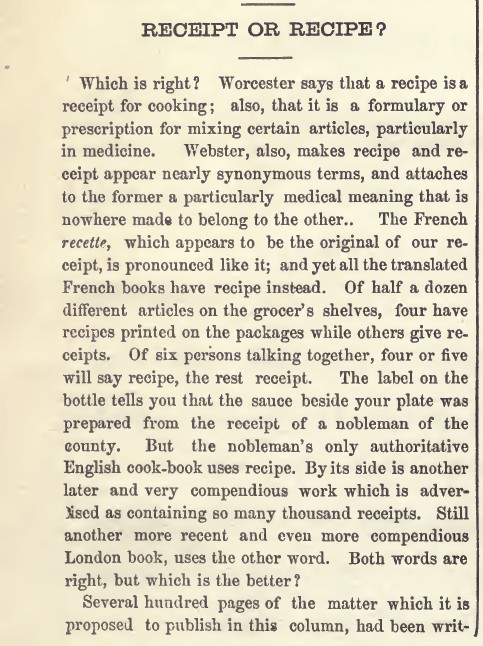
Which is right?

Worcester [Joseph Emerson Worcester, b. August 24, 1784 – d. October 27, 1865, was an American lexicographer who was the chief competitor to Noah Webster of Webster's Dictionary in the mid-nineteenth-century.] says that a recipe is a receipt for cooking ; also, that it is a formulary or prescription for mixing certain articles, particularly in medicine. Webster, also, makes recipe and receipt appear nearly synonymous terms, and attaches to the former a particularly medical meaning that is nowhere made to belong to the other.. The French recette, which appears to be the original of our receipt, is pronounced like it; and yet all the translated French books have recipe instead.

Of half a dozen different articles on the grocer's shelves, four have recipes printed on the packages while others give receipts.

Of six persons talking together, four or five will say recipe, the rest receipt. The label on the bottle tells you that the sauce beside your plate was prepared from the receipt of a nobleman of the county. But the nobleman's only authoritative English cook-book uses recipe.

By its side is another later and very compendious work which is advertised as containing so many thousand receipts. Still another more recent and even more compendious London book, uses the other word. Both words are right, but which is the better?

Several hundred pages of the matter which it is proposed to publish in this column, had been written with the word recipe, according to the observed practice of the majority, but after all it was decided to change it, and for reasons perhaps as immaterial as the difference between the two words in question.

Still, the minority side having been taken, it seems best to state the case.

A city man, wise in the ways of bread making, was at an old Yankee farmer's house instructing his housekeeper in the best methods of making homemade Boston brown bread, and used the word recipe frequently. The old man was not illiterate, but excessively old-fashioned, and the tri-syllable annoyed him past bearing.

He laid down the Churchman that he had been reading, and leaned back and listened.
Then he took off his glasses. Then he began to remonstrate.

"Oh, don't bring those affected city words among us plain people. 'Recipee,' " he repeated,
with immeasurable contempt.

"My parents always said receipt ; my neighbors all say receipt, what would they think of us if we should go among them putting on such airs as that ?"

As I overheard this, and a cutting phillipic which followed, aimed at city affectations in general, my faith in the power of high-sounding recipe to soothe the savage breast was considerably weakened. A long time after, and at a very distant place, a lady school teacher was heard to say: "I am so glad if receipt is the right word instead of recipe; the latter seems so much like a stranger in a foreign dress among our familiar English words of the same dimensions. When I have taught my pupils to indite and recite, it is troublesome to make them understand that recipe is not to be pronounced that way at all, and then, again, to stop them from making two syllables of ripe, wipe, and pipe."

This was another blow at the aristocratic trisyllable, but it seemed hard to have to descend from the lofty heights where it prevailed to the level of the common. Fortunately, just at that time, the great house of the Harpers published the most polite cook-book that has yet appeared. It made extreme correctness a special feature. It was typographically perfect.

It hyphenated every cocoa-nut. It split hairs on teaspoonful.

It followed Noah Webster whither-soever he might lead. It was "the glass of fashion and the mould—I mean mold—of form," and with all this it adopted receipt instead of recipe.

There was no more room for doubt. Higher precedent there could not be, and so, if the reader pleases, as far as this column is concerned, we will render unto the doctors the Latin trisyllable which is their, and use only the humbler but safer English receipt.

------END--------

Receipt or Recipe? Article taken from:


Volume 1 of the "Oven and Range" Series
The American Pastry Cook

7th EDITION
by Jessup Whitehead

CHICAGO:
Jessup Whitehead & Co., Publishers
1894

A book of perfected Receipts, for making all sorts of articles required of the Hotel Pastry Cook, Baker and Confectioner, especially adapted for Hotel and Steamboat [yes, it said steamboat] use, and for Cafes and Fine Bakeries.